Spotify growth depends on data signals. Artists track streams, saves, followers, and playlist adds every day. Among these signals, one comparison appears constantly: Spotify saves vs plays algorithm. Artists want to know which metric matters more and how Spotify evaluates both.
Spotify does not rely on a single metric. Spotify evaluates patterns. However, saves and plays represent two core signals that influence algorithmic behavior differently. This guide explains the Spotify saves vs plays algorithm, how both metrics work, and how to optimize them for real growth in 2026.
What Are Spotify Plays?
Spotify plays represent the total number of times a track is streamed. A stream counts when a listener plays a song for at least 30 seconds. This rule filters accidental clicks and extremely short listens.
There are three important characteristics of Spotify plays:
- Volume-Based Metric
Plays show how many times a song is consumed. - Repeatable Action
One user can generate multiple plays. - Surface-Level Signal
Plays indicate activity but do not always show listener satisfaction.
Spotify plays increase visibility when they grow consistently. However, plays alone do not guarantee algorithmic expansion.
What Are Spotify Saves?
Spotify saves represent the number of listeners who add a track to their library. A save indicates that a listener wants to return to the song later.
There are three important characteristics of Spotify saves:
- Intent-Based Metric
Saves show deeper interest than casual listening. - One-Time Action Per User
A user can save a track once, which makes the signal more meaningful. - Retention Indicator
Saves often correlate with long-term engagement.
Spotify treats saves as a stronger signal of listener satisfaction.
Spotify Saves vs Plays Algorithm: Core Difference
The Spotify saves vs plays algorithm focuses on engagement quality versus engagement quantity.
- Plays = Quantity of listening activity
- Saves = Quality of listener interest
Spotify evaluates how these two metrics interact. A high number of plays with low saves indicates weak engagement. A balanced ratio shows stronger audience connection.
Spotify prefers songs that maintain both volume and intent signals.
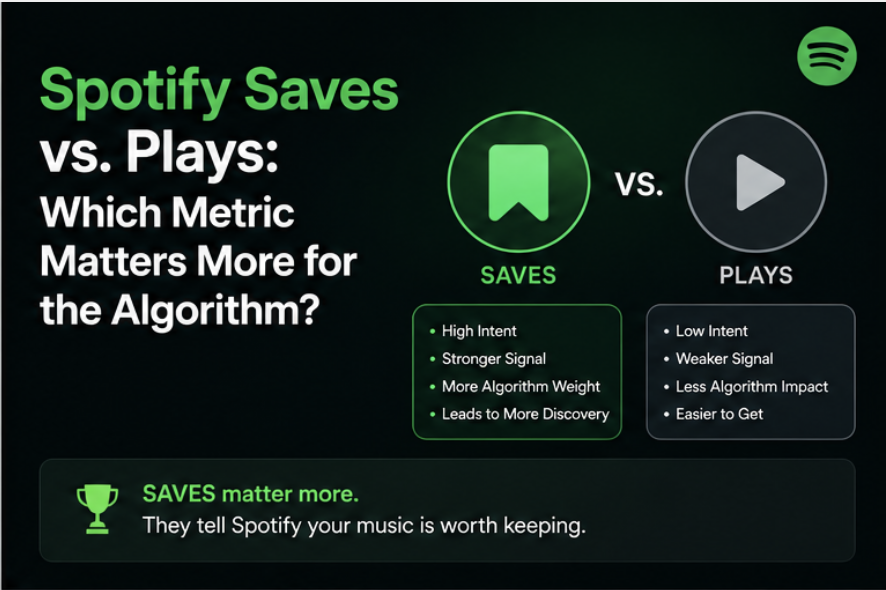
Why Spotify Saves Matter More Than Plays
Spotify saves often carry more weight because they reflect real listener behavior.
There are five reasons saves matter more:
1. Stronger Intent Signal
A save requires action. The listener chooses to keep the track. This action shows real interest.
2. Algorithm Trust Factor
Spotify trusts signals that represent long-term engagement. Saves indicate future listening behavior.
3. Playlist Eligibility
Songs with high save rates have better chances to enter algorithmic playlists.
4. Listener Retention Correlation
Tracks that receive saves often have higher completion rates.
5. Reduced Risk of Artificial Activity
Fake traffic can inflate plays easily. Saves are harder to manipulate consistently.
Spotify values signals that reflect genuine user decisions.
Why Spotify Plays Still Matter
Spotify plays still play a crucial role in growth.
There are four reasons plays matter:
1. Visibility Expansion
More plays increase exposure across the platform.
2. Data Collection
Spotify collects listener behavior from streams.
3. Algorithm Triggering
Initial play volume can trigger further testing by the algorithm.
4. Social Proof
High play counts attract attention from listeners and curators.
Plays create momentum. Saves sustain momentum.
Ideal Spotify Saves-to-Plays Ratio
The Spotify saves vs plays algorithm works best when both metrics grow together.
There is a commonly observed ratio:
- 0.20 to 0.35 saves per stream (20%–35%)
Example:
- 10,000 plays → 2,000 to 3,500 saves = strong performance
- 10,000 plays → 200 saves = weak engagement
Spotify promotes tracks with higher save ratios because they show real audience interest.
How Spotify Uses Saves and Plays Together
Spotify combines multiple signals into a unified evaluation system.
There are five key interactions:
- High Plays + High Saves
Strong signal → algorithm expansion. - High Plays + Low Saves
Weak signal → limited growth. - Low Plays + High Saves
Niche signal → potential targeted growth. - Low Plays + Low Saves
Weak performance → no expansion. - Balanced Growth Over Time
Stable signal → long-term algorithm support.
Spotify rewards consistency more than sudden spikes.
Which Metric Matters More in 2026?
The answer is clear when analyzing algorithm behavior.
Spotify saves matter more than plays for long-term growth.
Spotify plays matter more for short-term exposure.
The Spotify saves vs plays algorithm favors songs that generate both metrics in balance. However, saves drive sustainability.
How to Increase Spotify Saves
There are six practical strategies:
1. Improve Song Intro
The first 15 seconds determine whether listeners stay.
2. Use Clear Call-to-Actions
Ask listeners to save the track through social media.
3. Build Emotional Connection
Songs with emotional impact generate more saves.
4. Target the Right Audience
Relevant listeners are more likely to save.
5. Optimize Release Timing
Release when your audience is active.
6. Encourage Repeat Listening
Repeat plays increase the likelihood of saves.
How to Increase Spotify Plays
There are five main methods:
1. Playlist Placement
Playlists generate immediate streams.
2. Social Media Promotion
TikTok and Instagram drive traffic.
3. Influencer Collaborations
Creators expose music to new audiences.
4. Paid Advertising
Ads increase initial reach.
5. Consistent Content Strategy
Frequent releases keep audience attention.
Common Mistakes in Spotify Metrics Optimization
Many artists fail to balance saves and plays.
Avoid these five mistakes:
- Focusing only on play count.
- Ignoring save rate.
- Using low-quality traffic sources.
- Releasing without promotion.
- Targeting the wrong audience.
These mistakes reduce algorithmic performance.
How the Spotify Algorithm Reacts Over Time
Spotify evaluates data in stages.
There are three phases:
1. Initial Testing Phase
Spotify shows the track to a small audience.
2. Data Evaluation Phase
The algorithm measures saves, plays, and retention.
3. Expansion Phase
Strong performance leads to wider distribution.
Weak performance stops growth early.
FAQ: Spotify Saves vs Plays Algorithm
What is the Spotify saves vs plays algorithm?
It is the system Spotify uses to evaluate listener behavior based on play count and save activity.
Do saves matter more than plays?
Yes, saves indicate stronger listener intent and often carry more weight.
Can high plays without saves hurt performance?
Yes, low save rates can limit algorithmic expansion.
What is a good save rate?
A rate between 20% and 35% is considered strong.
Do saves affect playlist placement?
Yes, high save rates improve chances for algorithmic playlists.
Can new artists compete with high save rates?
Yes, targeted audiences can produce strong save ratios even with fewer plays.
Conclusion
The Spotify saves vs plays algorithm defines how music grows on the platform. Plays generate visibility. Saves confirm listener interest. Spotify prioritizes tracks that show both quantity and quality signals.
Artists who focus only on streams miss the bigger picture. Artists who build strong save rates create sustainable growth. The best strategy combines balanced play volume with high save ratios.
In 2026, success on Spotify depends on real engagement. Real engagement begins when listeners choose to save the music.