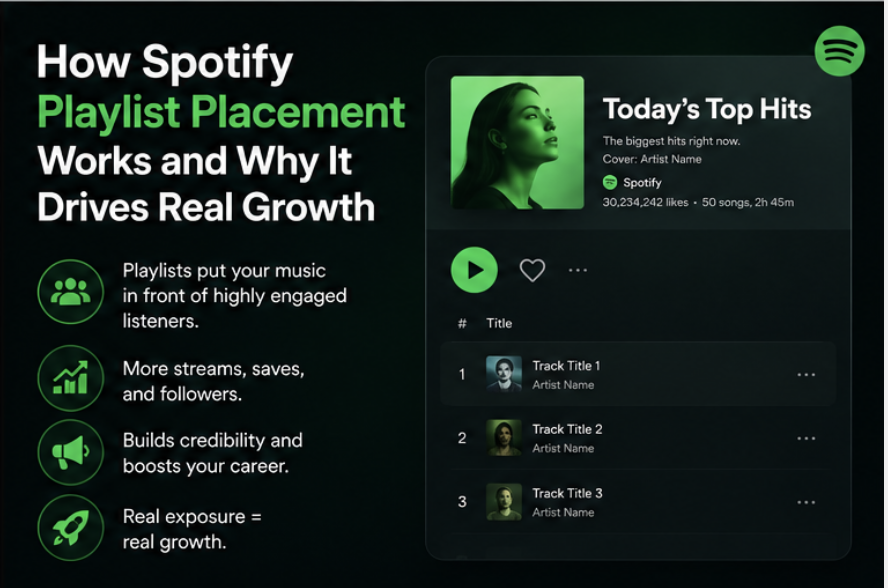
Spotify playlist placement is one of the most powerful growth mechanisms in the music industry. Artists, managers, and labels actively search for scalable promotion methods. Many of them rely on a Spotify playlist placement service to reach new listeners faster. The reason is clear. Playlists connect songs with ready audiences who already listen to similar music.
This guide explains how Spotify playlist placement works, why it matters, how a Spotify playlist placement service operates, and how to use playlisting safely for long-term growth in 2026.
What Is Spotify Playlist Placement?
Spotify playlist placement is the process of getting a song added to a curated playlist. A playlist can be editorial, algorithmic, or user-generated. When a song enters a playlist, it gains exposure to listeners who follow that playlist.
A Spotify playlist placement service helps artists submit songs to playlist curators, networks, or systems that manage playlist distribution. The goal is to increase reach, streams, and listener discovery.
There are three main playlist categories:
- Editorial Playlists
Managed by Spotify’s internal team. Examples include “RapCaviar” or “New Music Friday.” - Algorithmic Playlists
Generated automatically based on user behavior. Examples include Discover Weekly and Release Radar. - User-Curated Playlists
Created by independent curators, influencers, or brands.
Each playlist type has a different impact on growth.
How Spotify Playlist Placement Works
Spotify playlist placement follows a structured process. The process depends on data signals and audience behavior.
There are five core stages:
1. Track Preparation
Upload the song early. Fill metadata fields correctly. Include genre, mood, credits, and release details. Spotify evaluates this data.
2. Audience Priming
Create activity before release. Pre-saves, social media teasers, and fan engagement prepare the algorithm.
3. Submission Process
Use Spotify for Artists for editorial pitching. Use a Spotify playlist placement service for user-curated playlists.
4. Initial Performance Signals
Early listeners generate data. Spotify measures skip rate, completion rate, and saves.
5. Algorithm Expansion
Strong signals push the song into algorithmic playlists. Weak signals stop expansion.
The system works as a feedback loop. Good performance leads to more exposure.
Why Spotify Playlist Placement Drives Real Growth
Spotify playlist placement creates measurable growth because it connects music with real listeners.
There are six main reasons:
1. Immediate Audience Access
Playlists already have followers. A song reaches listeners without building an audience from zero.
2. Discovery Acceleration
New listeners find the track faster through curated environments.
3. Algorithm Activation
Playlist streams trigger algorithmic recommendations if retention is strong.
4. Social Proof
A song in multiple playlists looks credible. Credibility attracts more listeners.
5. Data Expansion
Spotify collects listener data. This data improves targeting for future releases.
6. Long-Term Momentum
Songs can remain in playlists for weeks or months, generating continuous streams.
Playlist placement builds both short-term and long-term growth.
What Is a Spotify Playlist Placement Service?
A Spotify playlist placement service is a platform or agency that connects artists with playlist curators. The service manages submissions, communication, and sometimes campaign tracking.
There are three main types of services:
1. Submission Platforms
Artists submit songs directly to curators. Curators review and decide independently.
2. Network-Based Services
The platform owns or controls a network of playlists. Placement happens inside this network.
3. Hybrid Services
The platform combines submissions, analytics, and campaign management.
Each type has advantages and limitations.
How to Choose the Right Spotify Playlist Placement Service
Choosing the right Spotify playlist placement service is critical. Not all services provide real results.
There are five evaluation criteria:
1. Transparency
The service should explain how playlists are selected.
2. Real Listener Activity
Check if playlists have engagement, not only followers.
3. Genre Matching
The service should match your music with relevant playlists.
4. Reporting System
A good service provides campaign data.
5. Support Quality
Fast support indicates operational reliability.
A strong Spotify playlist placement service focuses on long-term performance.
Editorial vs Algorithmic vs User Playlists
Understanding playlist types helps optimize strategy.
Editorial Playlists
Editorial playlists have the highest authority. Spotify’s team selects songs based on quality and data.
Advantages:
- High exposure
- Strong credibility
Limitations:
- Difficult to access
- Limited slots
Algorithmic Playlists
Algorithmic playlists depend on listener behavior.
Advantages:
- Scalable growth
- Personalized distribution
Limitations:
- Requires strong data signals
User-Curated Playlists
User playlists are accessible through submission or services.
Advantages:
- Easier entry
- Large volume opportunities
Limitations:
- Quality varies
A balanced strategy uses all three playlist types.
Metrics That Determine Playlist Success
Spotify evaluates performance through data signals.
There are six key metrics:
- Skip Rate
Lower skip rates indicate better listener interest. - Completion Rate
Full listens show strong engagement. - Saves per Stream
Saves show long-term interest. - Playlist Adds
Additional placements signal popularity. - Repeat Listens
Repeat streams show satisfaction. - Follower Growth
New followers indicate conversion.
A Spotify playlist placement service should improve these metrics.
Common Mistakes in Spotify Playlist Placement
Many artists fail because of incorrect strategies.
Avoid these five mistakes:
- Submitting to unrelated genres.
- Ignoring track quality.
- Using low-quality playlists.
- Expecting instant viral growth.
- Running campaigns without data analysis.
Mistakes reduce campaign effectiveness.
How to Increase Playlist Placement Success Rate
There are seven proven steps:
1. Optimize Song Quality
Strong production improves retention.
2. Build Pre-Release Hype
Pre-saves increase initial momentum.
3. Target Niche Communities
Specific audiences respond better.
4. Maintain Consistent Releases
Regular releases build algorithm trust.
5. Combine Social Media Traffic
External traffic supports Spotify data.
6. Analyze Performance Data
Adjust campaigns based on results.
7. Use Trusted Services
A reliable Spotify playlist placement service improves efficiency.
Success depends on consistency and data.
Is Spotify Playlist Placement Safe?
Spotify playlist placement is safe when done correctly. Risks appear when artists use low-quality or fake playlists.
Safe practices include:
- Choosing relevant playlists
- Avoiding artificial traffic
- Monitoring engagement metrics
- Using gradual campaign strategies
Safety increases when campaigns look natural.
How Long Do Playlist Results Last?
Playlist impact depends on performance.
There are three timelines:
- Short-Term Placement (1–7 Days)
Limited impact. - Mid-Term Placement (1–4 Weeks)
Moderate growth. - Long-Term Placement (1–3 Months)
Strong and sustainable growth.
Longer placements generate stronger results.
Does Playlist Placement Guarantee Success?
No, playlist placement does not guarantee success. It creates opportunity.
Success depends on:
- Track quality
- Listener retention
- Audience targeting
- Consistent promotion
A Spotify playlist placement service increases probability, not certainty.
FAQ: Spotify Playlist Placement Service
What is a Spotify playlist placement service?
A Spotify playlist placement service connects artists with playlist curators to increase exposure.
Are playlist placement services worth it?
They are valuable when they provide real listeners and relevant targeting.
Can playlist placement increase streams?
Yes, playlists can significantly increase streams when engagement is strong.
Is playlist placement safe?
It is safe if the service uses real listeners and relevant playlists.
How fast can results appear?
Results can start within days but grow stronger over weeks.
Do playlists help algorithmic growth?
Yes, strong playlist performance can trigger algorithmic playlists.
Conclusion
Spotify playlist placement is a core growth strategy in 2026. A strong Spotify playlist placement service connects artists with relevant audiences and accelerates discovery. Playlist placement works because it creates real listener interaction and supports algorithmic expansion.
Artists should focus on quality, data, and consistency. Playlists provide exposure, but sustained growth comes from listener behavior. When playlist placement and audience engagement work together, real growth becomes possible.